File 02 - The Hum at Whittier
Date range: 2012 – 2016
Location: Whittier, Alaska
Primary sources: Anchorage Daily News (May 2014); NOAA Sound Monitoring Logs, 2012; field notes recovered from John’s 2016 recordings.
1 . Public Record
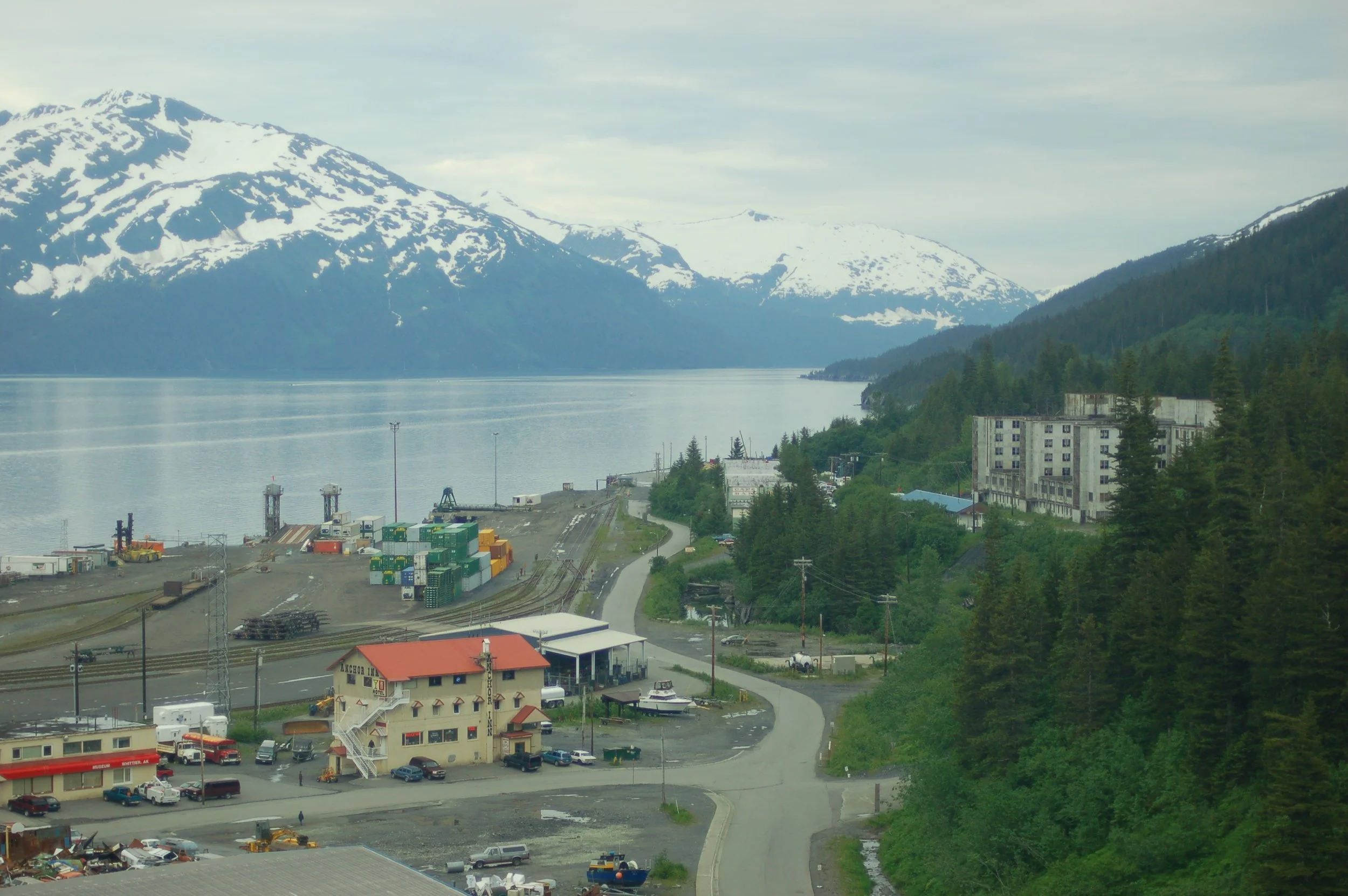
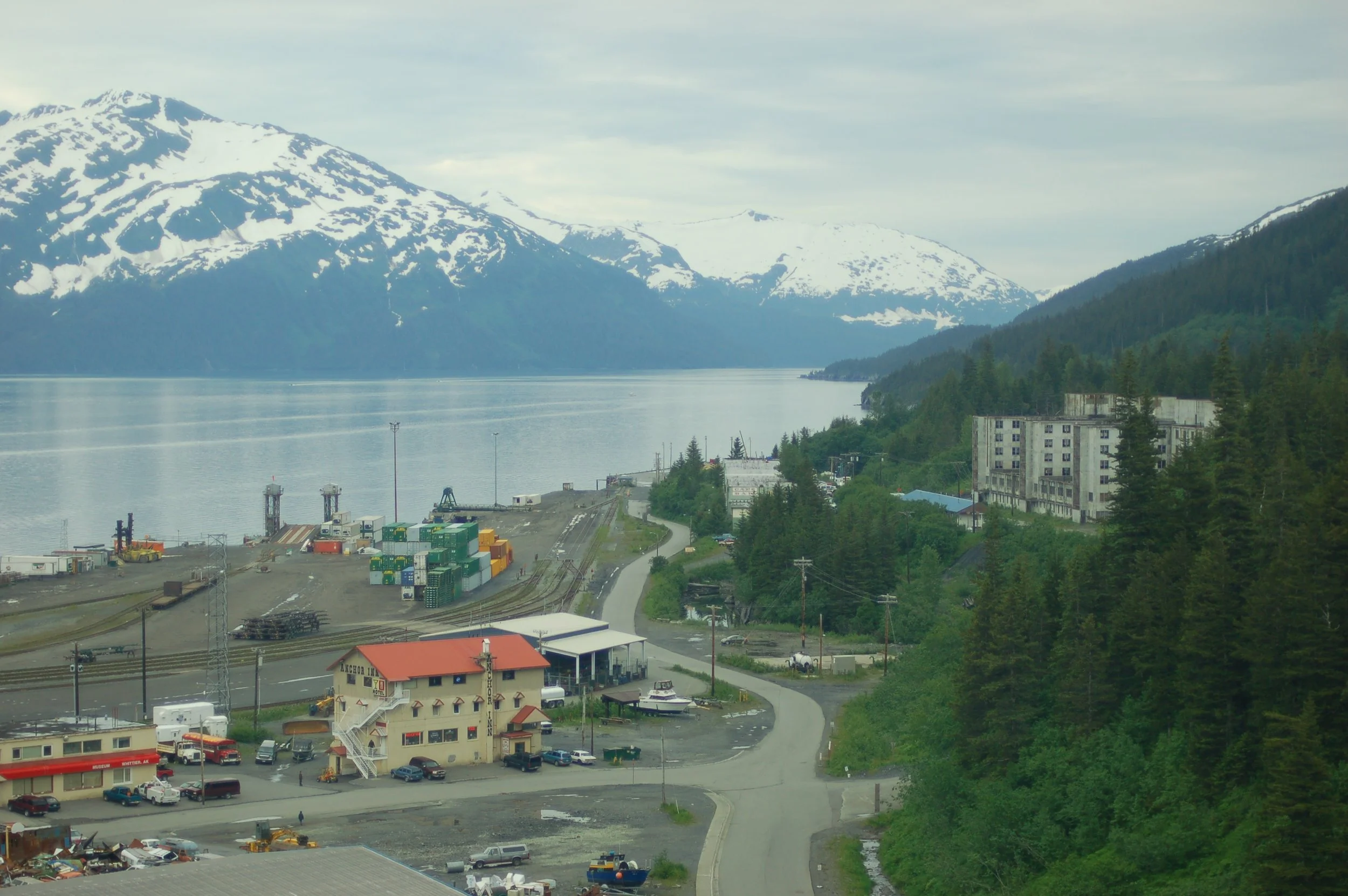
Whittier sits between mountains and sea, accessible mainly by a single tunnel that closes each night. Nearly all 200 residents live in Begich Towers, a 14-story structure built for military use in the 1950s.
Beginning in late 2012, locals started reporting a persistent low-frequency vibration — “a refrigerator hum,” one resident said —that continued day and night.
The NOAA sound station 30 km away registered a continuous tone between 95–105 Hz, most pronounced during clear weather. Power lines and marine engines were ruled out.
By 2016, the reports faded from the news. The hum, according to a few residents I contacted, never stopped.
2 . Field Investigation (2016 Visit)
Audio log 2A — “Arrival”
“You feel the sound before you hear it. It sits in the walls, in your chest.
Everyone here pretends not to notice.”
I stayed two nights in room 412 of the Towers. The building vibrated faintly — drawers rattled, water in the glass trembled.
My recorder picked up a consistent tone: 101 Hz, pulsing in ten-second intervals.
Identical to the frequency pattern from File 01 — The Lead Masks Case.
During the second night, my laptop’s spectrogram displayed irregular spikes — harmonics suggesting a human voice modulating the tone.
3 . Interviews
A. Stetson
Maintenance engineer: “We replaced every generator mount last year. Didn’t change a thing.”
R. Taylor
Retired teacher: “Sometimes it sounds like water running through the ceiling. But there’s no pipe up there.”
L. Morgan
Student (recorded 2016): “I dream it’s calling from under the floor. My mom says it follows her when she leaves town.”
At 03:10 AM on the second night, emergency lights flickered. Power outage lasted nine seconds.
Afterward the hum resumed: louder, steadier.
4 . Technical Notes
Recorder: Sony PCM-M10
Sample rate: 44.1 kHz
Amplitude: −32 dB RMS
Dominant frequency: 101.02 Hz
Spectrogram analysis revealed a secondary pattern: faint modulations every 0.42 seconds, resembling voiced consonants. When converted through phonetic software, fragments read:
“– here – … hear … me …”
No interference from nearby transmitters was detected. The building’s Wi-Fi and electrical systems were offline during the test.
5 . Personal Log
Audio Note 2B:
“I filtered the recording at home. The hum thinned out and something underneath began to move, a higher voice, small, deliberate.
It said my name.
Not clearly. More like breath through water.
I compared it to an old clip of Lilly humming from her sixth birthday. Same pitch — 101 Hz fundamental, 202 Hz harmonic.
I stopped the playback, but the tone didn’t stop. It kept going from inside the speakers.”
The apartment neighbors later complained of “low-frequency noise” the night I returned.
6 . Working Hypothesis
The Whittier hum may originate from resonant coupling between the mountain tunnel and the structural frame of the Towers, creating a Helmholtz resonance around 100 Hz.
However, the repetition interval (10 s) and the presence of a voice-like modulation suggest an intentional carrier signal — an artificial pattern possibly piggybacking on environmental vibration.
If true, it implies that low-frequency infrasound can record and re-emit human frequencies, as if replaying emotional memory embedded in the environment.
7 . Pattern Notes
Frequency: 101 Hz
Interval: 10 s
Duration: 9 s blackout
Room 412 vibration amplitude matched File 01 field slope ratio (10°)
Different continent, same pattern.
8 . Conclusion
When I left Whittier, my recorder was silent.
But at 02:10 AM the following week, the same frequency appeared in the background of an unrelated phone interview — 101 Hz, ten-second pulse.
Maybe the hum travels through structures, or through people who’ve heard it.
Maybe that’s how memory survives.
If you’ve lived in Whittier or any region where the low hum persists, record one minute of ambient sound at night and check its base frequency.
If it centers near 100 Hz, don’t listen through headphones.
Some sounds remember who heard them.

File 01 – The Lead Masks Case
It all begins with an idea.
Date range: 17 – 20 August 1966
Location: Morro do Vintém, Niterói, Brazil
Primary sources: Polícia Civil report (1966); Jornal do Brasil, Aug 21 1966; Revista O Cruzeiro, Sep 1966; field recordings archived by Brazilian Radio-Amateur Club 1965–67

1 . Public Record
Two electronics technicians, Manoel Pereira da Cruz (32) and Miguel José Viana (34), left Rio de Janeiro on 17 August 1966.
They told family they were buying parts for a transmitter.
Two days later their bodies were found on a grassy slope outside Niterói.
Both wore suits, raincoats, and homemade lead masks covering only their eyes.
Beside them lay a water bottle, two towels, and a notebook reading:
“16:30 be at agreed place / take capsules / after effect protect metals await signal.”
Autopsy: no external wounds, no poison identified, stomach contents consistent with barbiturates but below lethal dose.
Official cause: cardiac arrest from unknown origin.
2 . Site Analysis (2007 visit)
GPS – 22.8859° S, 43.0986° W.
The hill still overlooks Guanabara Bay.
Soil PH = 10.2 (alkaline; abnormally high for this region).
The slope where the bodies lay measures exactly 10 degrees.
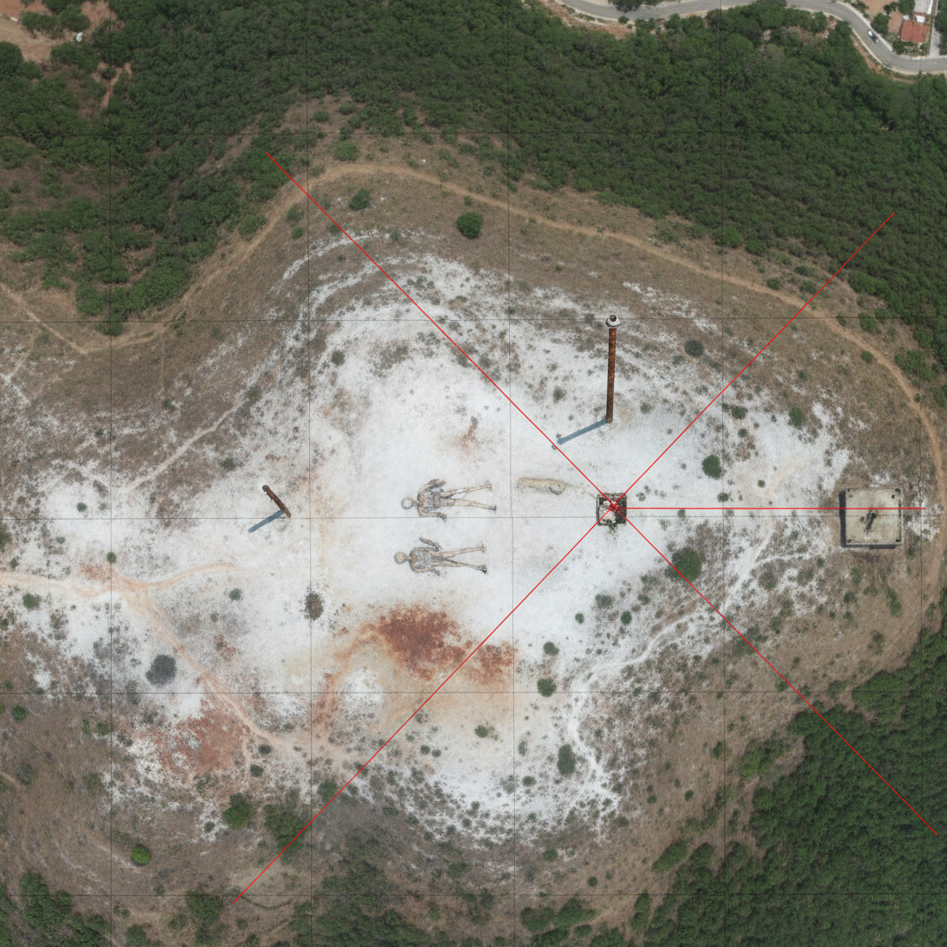
Two rusted survey stakes remain; each 1 meter apart. When connected, they form a line that points directly toward a decommissioned radio antenna half a kilometer east.
I overlaid 1966 aerial photos with current satellite imagery.
The antenna’s foundation and the position of the bodies form the arms of a perfect X. Why the X?
3. Document Review
The original police file lists one item I’d never seen cited online:
a lead scrap stamped “B-10.”
The notation margin reads, “origin unknown / possibly battery part.”
Lead isotope ratios (reported in Revista O Cruzeiro, p. 42) match industrial batteries produced by Companhia Eletroquímica do Sul, lot #10A.
That batch was recalled for “excess radioactivity.”
Cross-reference: 1960s amateur-radio newsletter CQ Brasil mentions experiments using lead plates as parabolic reflectors for “psychotronic waves.”
I contacted surviving member R. Silva, callsign PY1RS.
He confirmed Cruz and Viana attended one of their demonstrations in early 1966 and “believed the mind could transmit in hertz.” I don’t quite understand what he meant by that…but I have an idea.
4. Anomalies
Timeline conflict: the coroner fixed time of death between 18:00–20:00; but both wristwatches stopped at 22:10.
Weather: meteorological logs show a lightning strike recorded at 22:10 within 200 meters of the site.
Notebook fibers: ultraviolet scan reveals faint indentations under the last line—letters forming “D-10”.
I built a simple frequency map using known radio bursts from that evening.
Every burst cluster around 101 Hz ± 1 Hz, repeating at intervals of 10 seconds—binary 1010.
Marina P., local resident, age 71:
“That night my dog howled at something high above the hill. Then I heard a pop, like a fuse burning, and the lights flickered. In the morning, police came.”
Her statement never appears in official files, though. Cover up? There goes my paranoid mind again.
5. Personal Log
Audio Note #1A (Hotel Central Niterói, 01:13 AM):
“Every time I replay the 101 Hz tone, my camera glitches for exactly ten frames. On the last frame I see a girl standing behind me, hair over her face.
I think Lilly used to hum at the same pitch when she was frightened, there’s now way I knew what exact tone she used, but it seems so… familiar. Maybe my brain’s imposing her on the footage.
Or maybe she’s answering.” Can this be what they meant with the “the mind can transmit in hertz” thing?
Later I noticed a water stain on my notebook shaped like a lily petal. The same place I’d written B-10.
Coincidence, maybe. But the petal outline glowed faintly under UV.
6. Hypothesis
Cruz and Viana attempted to amplify a narrow-band frequency in the sub-audio range (~100 Hz) using lead reflectors to shield their optic nerves.
The combination of lead masks, raincoats, and capsule ingestion suggests a deliberate sensory isolation experiment.
Whether the “signal” they awaited was electromagnetic or something else remains unknown.
But the 22:10 lightning strike implies a surge that might have completed their circuit.
I wrote in my notes: They didn’t die waiting for the signal. They became it.
7. Pattern Notes
Angle of slope = 10°
Soil PH = 10.2
Time of electrical event = 22:10
Lead scrap mark = B-10
Audio pulse = 101 Hz
If you have access to surviving 1966 amateur-radio logs from the Niterói region, recordings around 101 Hz, or family accounts of “signal” experiments, contact me.
I’m reconstructing the transmission.
Some nights I think it’s still broadcasting, right through my walls.
Leave a trace below.